
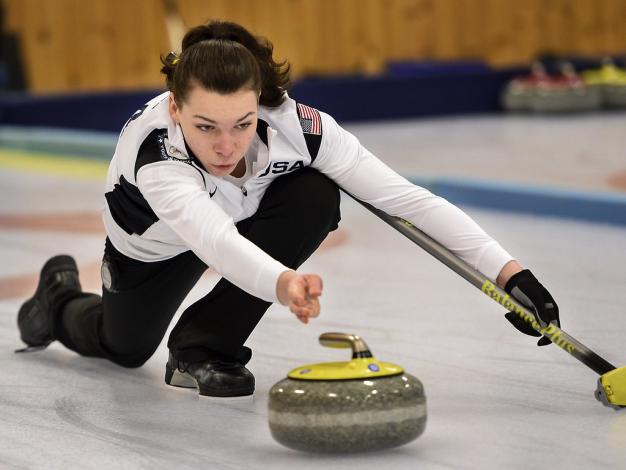
Curling is an Olympic Sport in which two teams take turns sliding heavy granite stones (called rocks) across a stretch of ice. The goal is to land the stones closest to the target in order to earn a point for that round. After 10 rounds, whichever team earned the most points wins the game.
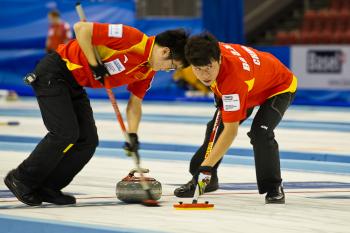
On their turn, a team works together to move the rock. One player throws a rock by launching it across the ice. The other players on the team use special brooms to sweep the ice around the stone. This helps direct, or curl, the rock towards the target.
Curling is an event in the Winter Olympics. While it debuted at the 1924 Olympics, the sport was not included again until 1998. Traditional teams include four players. A mixed doubles division (a team of one male and one female) was added to the Olympics in 2018. Notable US curlers include John Shuster and Tabitha Peterson.
These articles are written by library staff using library resources such as books, eBooks, and databases. Information can vary from book to book and database to database. Tickle Your Brain is meant to be a jumping off point for starting conversations about new topics of learning. It is not to be used as an authoritative resource.
- Curling was one of the 16 events included in the first Winter Olympics in 1924. The competition was held in Chamonix, France.
- The Team USA won its first Olympic gold medal in curling at the 2018 Pyeongchang Winter Olympics. Canada is the most successful country with 11 medals, six of which are gold.
- Team captains are called skips. They call shots through a variety of verbal direction and physical gestures.
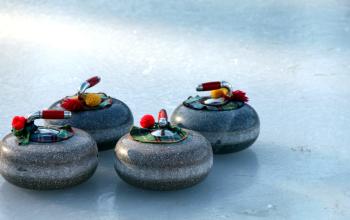
- The rocks are made of granite and weigh about 44 pounds or 20 kilograms.
- Curling is often referred to as “the roaring game” because of the rumbling sound created by the rock as it slides on the ice.
- Curling, by Ashley Gish
- The Olympics Encyclopedia, by Chrös McDougall
- Curling, by Annalise Bekkering